
New Archives Exhibition Traces Carnegie Tech’s Transformation During World War I
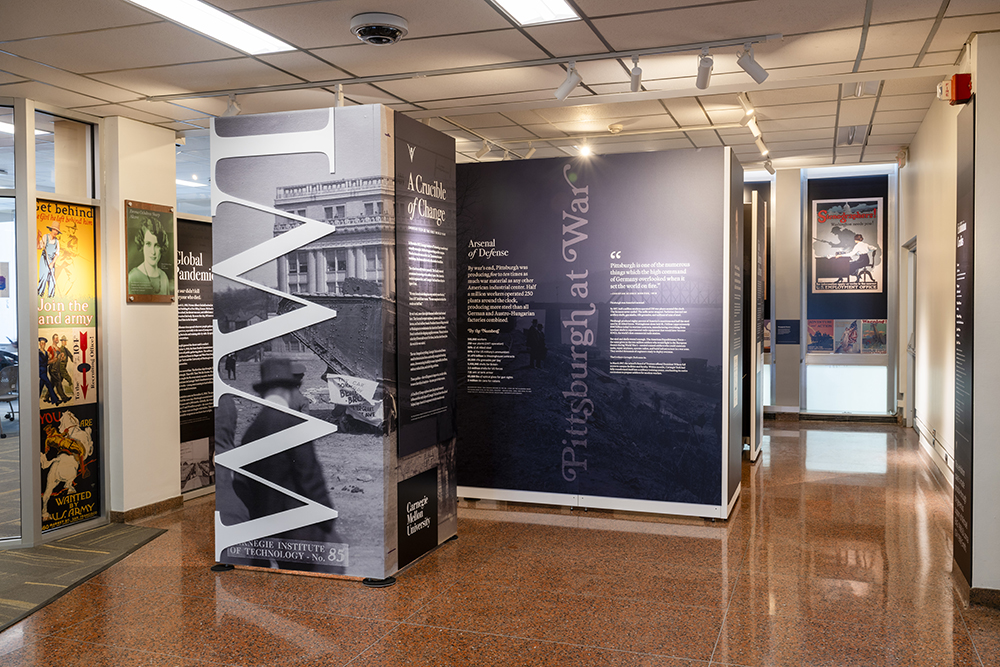
In 1917, the Carnegie Institute of Technology was only 12 years old, still establishing its identity as a technical school in Pittsburgh. America’s entry into World War I abruptly changed its trajectory. Within months, classrooms, laboratories, and even the landscape of campus were being adapted to support a national mobilization, testing the young institution’s ability to respond at extraordinary speed and scale.
The University Archives’ new exhibition “A Crucible of Change: Carnegie Tech and World War I” traces that transformation. Presented across Hunt Library and Baker Hall, the exhibition draws on letters, photographs, artifacts and other materials from the University Archives and partner collections to tell a story that extends across campus — much as the war itself did more than a century ago.
Together, the installations explore how the difficult period tested the adaptability, creativity and bravery of the university community. They tell the stories of students, faculty and staff who supported the war effort as well as those who opposed it, while examining the lasting effects of the conflict on the university and the people who called it home.
“World War I was a period of extraordinary change and adaptation on campus that helped shape the Carnegie Mellon we see today,” said Michael and Lonna Smith University Archivist and Associate Dean for Distinctive Collections Julia Corrin, who curated the exhibition. “We're grateful to have a chance to share this story with our campus community.”
“Camp Carnegie”
For Carnegie Tech students, the war transformed daily life almost as quickly as it transformed the institution.
When the U.S. Signal Corps asked Carnegie Tech to develop a training course in radio and buzzer operation, the school had just three days before 400 soldiers arrived on campus. It was the beginning of a much larger mobilization explored through the “Nation at War” and “The War Courses” sections of the exhibition in Baker Hall.
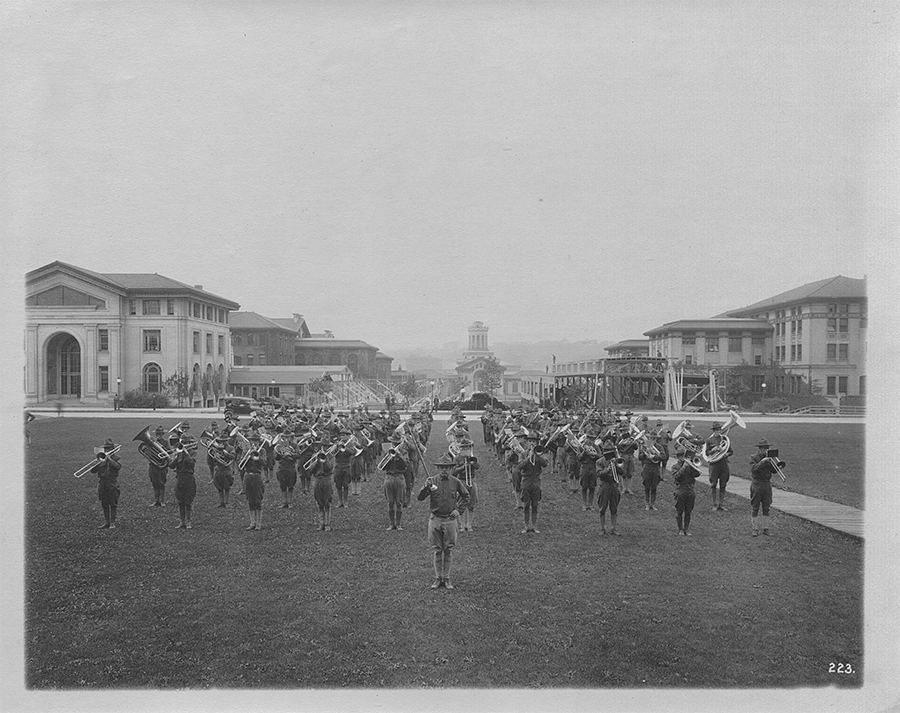
Over the next year, Carnegie Tech developed 13 additional war courses, putting its technical expertise to work preparing soldiers for an increasingly mechanized conflict. Training encompassed radio and buzzer operation, automobile and airplane maintenance, radio engineering, blacksmithing, coppersmithing, mechanical drafting, truck driving and other specialties. Carnegie Tech also operated a bandmaster training program, preparing two 50-person military bands through an intensive eight-week course.
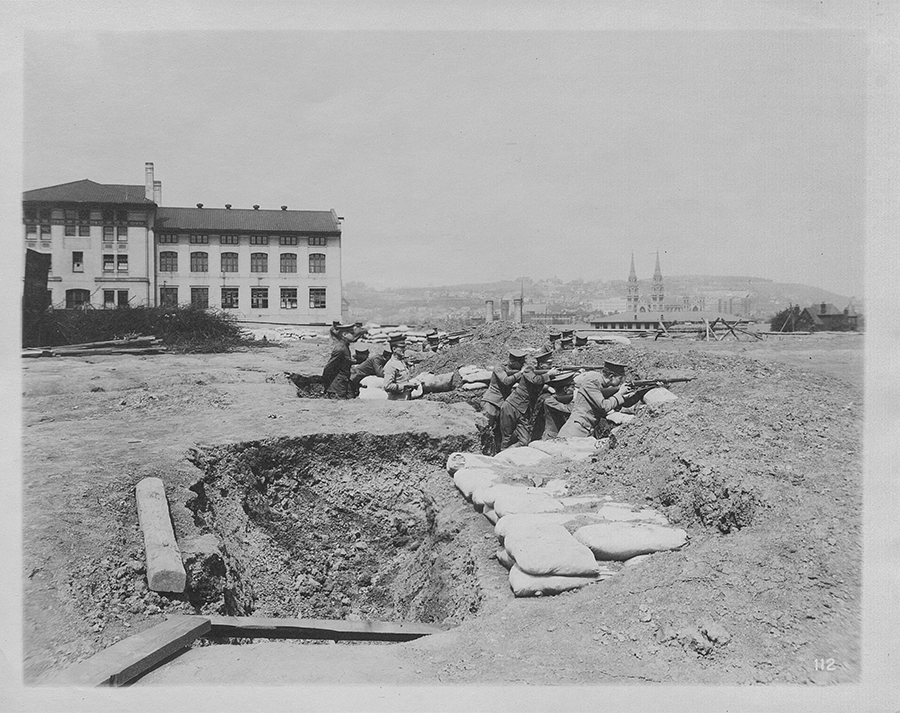
For students, those changes were impossible to separate from everyday campus life. Wooden barracks rose on The Cut to house 1,000 men. An airplane hangar was built in 30 days, workshops expanded nearly overnight, and an outdoor forge was constructed for blacksmith training. Students marched and drilled, practiced grenade throwing and dug trenches in nearby Schenley Park. The campus was simultaneously a school, construction site, and military training ground.
The war also transformed opportunities for women. As explored in the exhibition’s “Women in War” section, Margaret Morrison Carnegie School developed intensive courses in stenography for government offices, chemical analysis for steel plants, and occupational therapy for disabled soldiers. Steel companies and laboratories recruited women chemists for wartime work, only for many of those opportunities to disappear when the war ended.
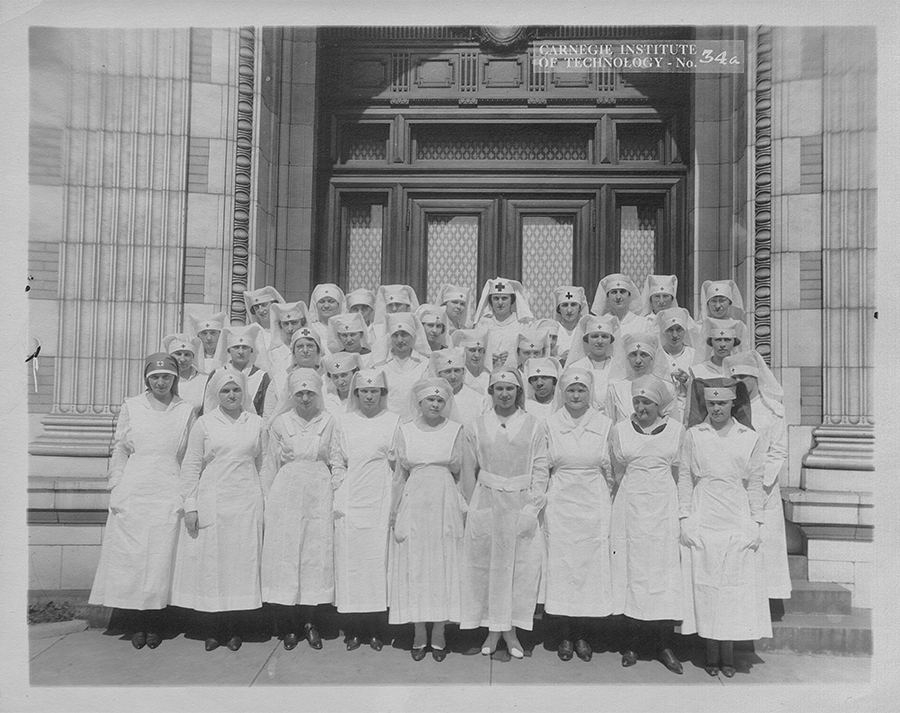
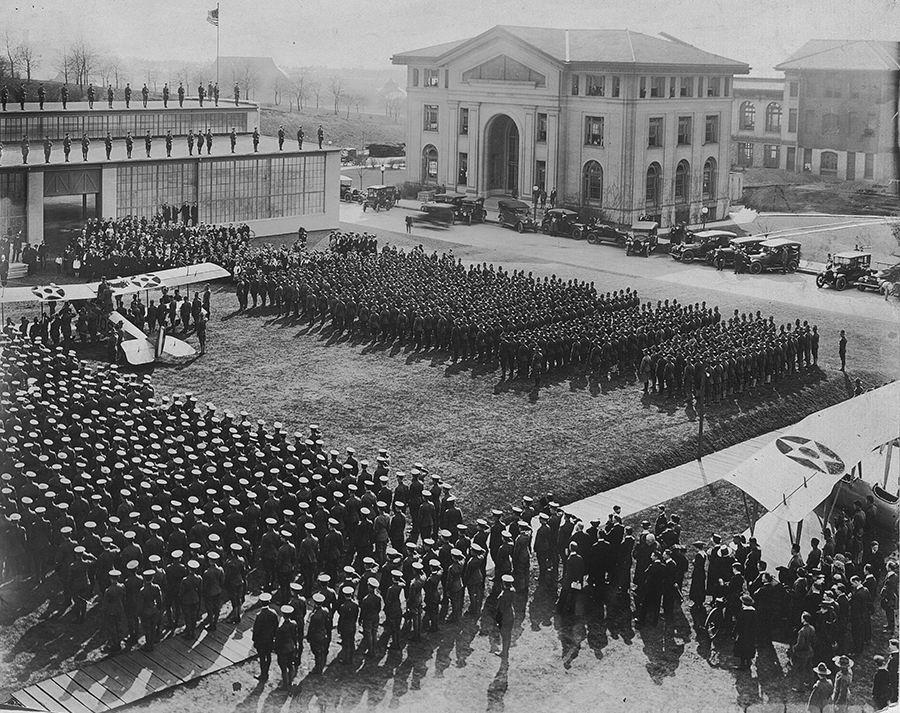
By fall 1918, of the 3,593 students on campus, only 486 were civilians, most of them women. The rest wore uniforms.
“It is hard to imagine today just how much life changed on campus for students in 1918,” said Corrin. “One day, you came to campus for a football game. The next day, you were in a different kind of uniform practicing how to use a bayonet and learning military tactics.”
Lasting Legacy
More than a century later, the material record of that transformation forms the foundation of “A Crucible of Change.”
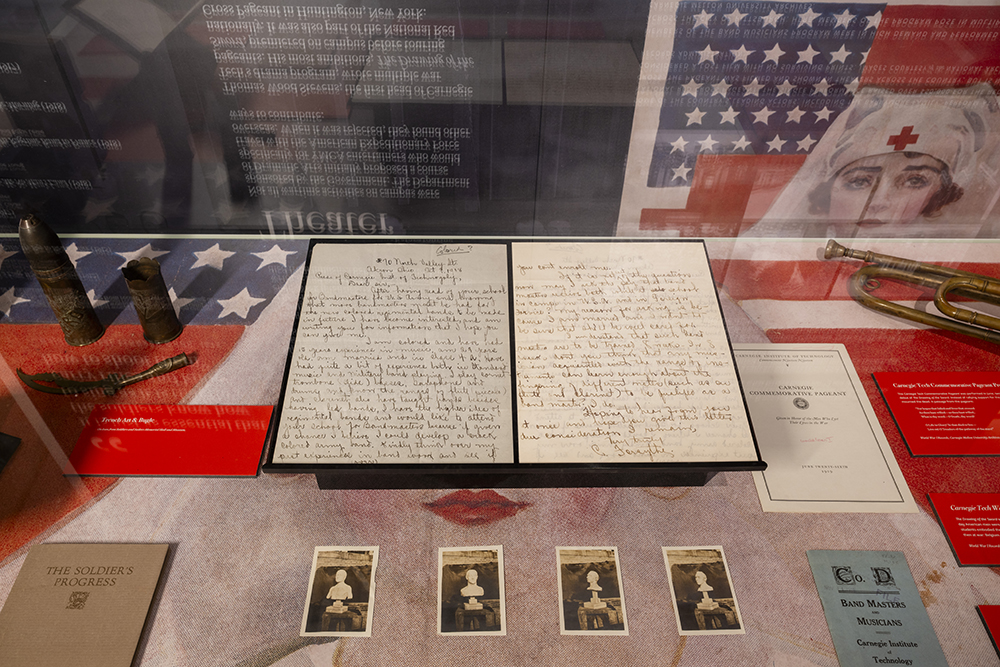
Striking black-and-white photographs throughout the Hunt Library installation show a campus reshaped by the war. In display cases, uniform coats, signal flags, a gas mask, mess kit, and more give physical form to experiences documented in photographs and written records.
“The University Archives mostly collects two-dimensional objects, such as documents and photographs. We're very grateful to our partners at Soldiers & Sailors Memorial Hall & Museum, who let us borrow artifacts to bring the story to life,” said Corrin. “These objects, which Pennsylvania soldiers carried with them overseas, help us remember that history happened to real people. They help us put ourselves in the shoes of students at that time.”
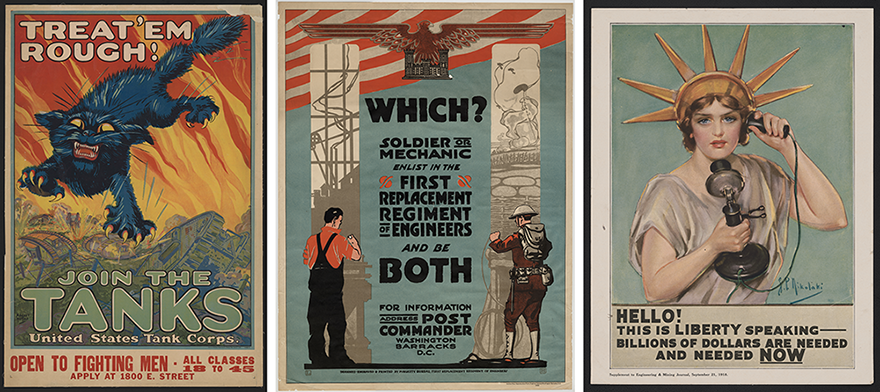
Together, those materials allow the exhibition to look beyond military training to the ways war reached nearly every part of life at Carnegie Tech and throughout Pittsburgh. “Pittsburgh at War” places the university within an industrial city producing war material on an enormous scale, while “Civil Liberties and Protest” examines the disappearance of organized opposition to the war from campus as federal restrictions tightened and military participation became embedded in university life.
Another section explores how music, theater, art and writing became outlets for responding to the conflict. Carnegie Tech trained military bands, and members of the drama program contributed through performance and wartime pageants. English faculty member Haniel Long collected letters and poetry written by Carnegie Tech men in service, publishing them in “The Soldier’s Progress and Carnegie Tech War Verse” in 1918.
The surviving record also documents the human cost of that transformation. While the record is incomplete, approximately 900 Carnegie Tech students, alumni and faculty are known to have served during World War I. At least 44 students died in service.
History Across Campus and Beyond
The end of the war did not end its presence on campus.
Seven men’s residence halls — Henderson, Boss, McGill, Miller, Engelbrecht, Scobell and Welch — were named for Carnegie Tech students and alumni who lost their lives during the war. Plaques at the buildings commemorate those students; now, updated versions will add historical context about the people behind the names and their connections to Carnegie Tech. The new plaques will be installed for Veterans Day this year.
“Very few people know that these dorms were named for fellow students, not donors or university administrators,” said Corrin. “This is a chance to remember the sacrifices that these students — football players, writers for the Tartan, honors scholars — made.”
That effort to make the university’s history more visible is also reflected in the growing footprint of the University Archives exhibition program. What began with exhibitions in the Hunt Library gallery has expanded into spaces where members of the CMU community encounter history as part of their everyday routines. Installations now reach locations including the Robotics Innovation Center at Hazelwood Green and Maggie Murph Café, while the Baker Hall component of “A Crucible of Change” brings archival storytelling directly into an academic building.
“Every space offers a different way into a story,” said Associate Director of Creative and exhibition designer Heidi Wiren Kébé. “When we bring exhibitions into the places where people study, work, and gather, we create opportunities for unexpected encounters with the Archives. Through thoughtful design, we can make those histories feel immediate and intimate. We help people see themselves as part of a larger, evolving story.”
The exhibition now extends beyond campus as well. Material from “A Crucible of Change” is on view at the Pennsylvania Governor’s Residence in Harrisburg, the official home of the governor since 1968 and a public space that uses art, historic objects, and educational programming to connect visitors with the Commonwealth’s history and culture.
“Taking this work beyond campus allows us to connect Carnegie Mellon’s history with broader Pennsylvania history,” said Kébé. “At the Governor’s Residence, Carnegie Mellon becomes part of a broader conversation about Pennsylvania and the people who shaped it. As a designer, I’m interested in how images draw someone closer, make a distant experience tangible, and how those encounters invite viewers to recognize themselves in a history they may not have considered theirs.”
Visitors can experience “A Crucible of Change: Carnegie Tech and World War I” across Hunt Library and Baker Hall through July 9, 2027, exploring how a global conflict transformed the young Carnegie Tech and the students, faculty and staff who called it home.