

As artificial intelligence becomes increasingly common in classrooms and workplaces, students are facing new questions about when and how to use it responsibly. While many instructors are still determining how AI fits into their courses, students are looking for practical guidance that goes beyond simple rules or restrictions.
Sarah Mansfield, a Ph.D. candidate in rhetoric and first-year writing instructor, wanted her students to approach AI as one tool among many. The Writing & Communication Program, which oversees first-year writing classes, has a program-wide focus on integrating assignments and activities into courses to help students develop critical AI literacy. So rather than telling students to embrace or avoid the technology, she encouraged them to think critically about when AI could support their learning and when traditional research and writing practices were more appropriate.
“Like all other tools, it’s important for students to think about when it’s appropriate to use AI in the classroom, and when it isn’t,” Mansfield explained. “Research shows that students overwhelmingly want more guidance about how and when they can turn to it. First-year students may also have a harder time evaluating how successfully AI-generated writing is communicating because they’re less experienced with these genres.”
After hearing Arts and Humanities Librarian Charlotte Kiger Price and Research Data Librarian Alfredo González-Espinoza present during the Writing and Communication Program's annual reorientation, Mansfield invited them into her "Writing About Data" first-year writing course. Their balanced approach to AI — grounded in research, information literacy, and the Libraries' expertise — gave students a new framework for thinking about emerging technologies.
Goal
- Help students develop the judgment to decide when and how AI can appropriately support their research and writing.
- Give students practical experience with emerging research tools and offer them opportunities to explore how those tools could fit into their own research processes.
How We Helped
- Kiger Price and González-Espinoza visited Mansfield's first-year writing course to demonstrate institutionally supported AI tools, including Keenious and Gemini Notebook (formerly NotebookLM), and discuss their strengths and limitations.
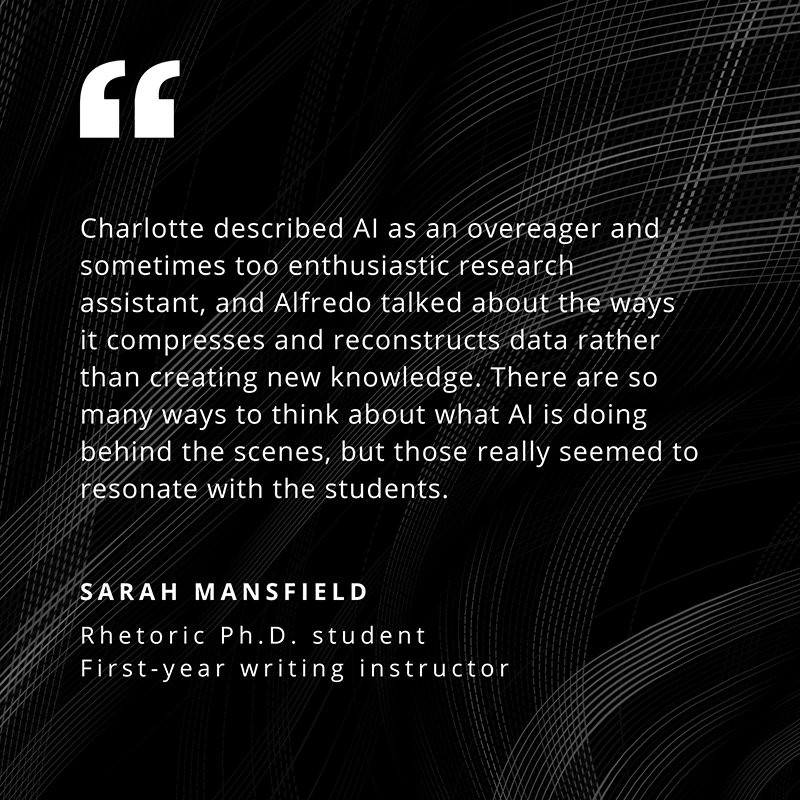
- They shared practical frameworks for evaluating AI. “Charlotte described AI as an overeager and sometimes too enthusiastic research assistant, and Alfredo talked about the ways it compresses and reconstructs data rather than creating new knowledge,” Mansfield said. “There are so many ways to think about what AI is doing behind the scenes, but those really seemed to resonate with the students.”
- They introduced students to the Libraries as a neutral resource where they could continue asking questions about AI and research beyond the classroom.
Results
- Students learned about AI-powered research tools they hadn't previously encountered and began to apply them while developing literature reviews.
- The librarians' frameworks gave students a shared vocabulary for ongoing class discussions about when AI could support their learning — and when using it might undermine what an assignment was intended to teach.
- Students left with new connections to Libraries experts as a neutral resource who can continue supporting their research as AI technologies evolve. “I like that the students can follow up with librarians for help with their other courses, develop a relationship, and get help for other things,” Mansfield said. “And since Charlotte has a humanities background and Alfredo has a STEM background, they can speak to different needs and use cases than I can, offering students support regardless of their field.”