by Sarah Bender
After a major renovation, the Posner Center for Special Collections at the Carnegie Mellon University Libraries has opened its doors once more — this time as a vibrant hub for teaching, research, and public engagement. Within just days of reopening, students from across CMU and the University of Pittsburgh became the first to test the possibilities of the new space, engaging directly with rare books, archival materials, and historic technologies.
Designed as both a museum and a working laboratory for the humanities, the Center now serves as an expanded home for CMU’s Special Collections thanks to an $8 million commitment from the Posner Foundation of Pittsburgh. The renovation enhances public access, strengthens preservation, and introduces a flexible classroom that supports everything from lectures to immersive, material-based learning.
It’s a setting built for exploration, and students are already taking full advantage. Across disciplines, the Center serves as a shared environment where courses in the arts, humanities, sciences, and technology can draw on rare materials to illuminate connections that span fields and centuries.
Classic Children’s Literature
For Department of English Assistant Professor Atesede Makonnen, the Posner Center offered a unique opportunity for her students to experience texts materially, exploring them through touch as well as written content. Makonnen teaches “Books You Should Have Read By Now: Classic Children’s Literature,” a course focused on the history and importance of children’s literature through nineteenth- and twentieth-century fantasy novels.
“On day one of the class, I brought in a fairytale book from 1925, and the students didn’t touch it — they might have been worried about its fragility,” Makonnen said. “I really wanted them to have a chance to handle these books and think about them through the lens of interacting with the material object. I’m excited that the Posner Center provides a way to engage with older texts in a way that might feel a little safer for them to explore.”

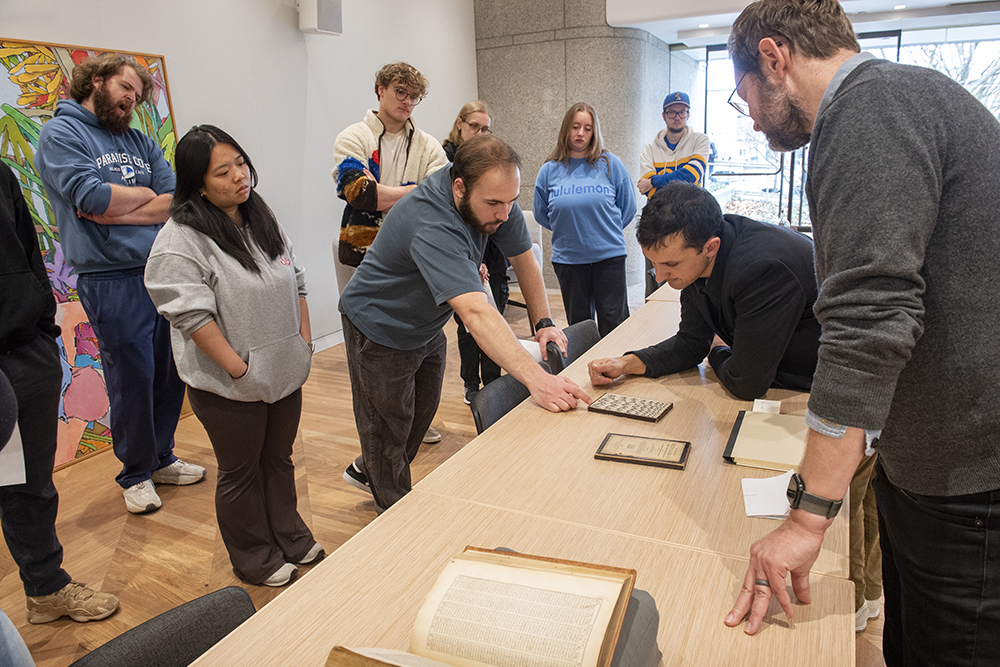
During their visit to the Posner Center, curator of Special Collections Sam Lemley showed Makonnen’s students copies of Lewis Carroll’s “Alice” novels from the 1860s and 1870s, illustrated editions of fairytales by Hans Christian Andersen and Jacob Grimm, and more. For the first time, students could handle historic versions of the texts, experiencing firsthand how children from centuries past might have used them.
“A lot of what we’re reading this semester is out of copyright, so I gave my students the option to read an ebook version through resources like Project Gutenberg,” Makonnen explained. “But I really want them to be thinking about the actual object, too: the quality of the paper, the material production of the illustrations. We’re talking about things like font size, and how easy it is to turn a page. Being able to touch these texts adds a new dimension to thinking about what it means to be a reader.”
Writing Machines
Special Collections resources are available to the wider Pittsburgh community as well, including neighbors at the University of Pittsburgh. For Department of Information Culture and Data Stewardship Teaching Associate Professor Matthew Burton’s class “Writing Machines,” visiting the Posner Center was the perfect opportunity for students to explore the history of machines designed to automate writing tasks.
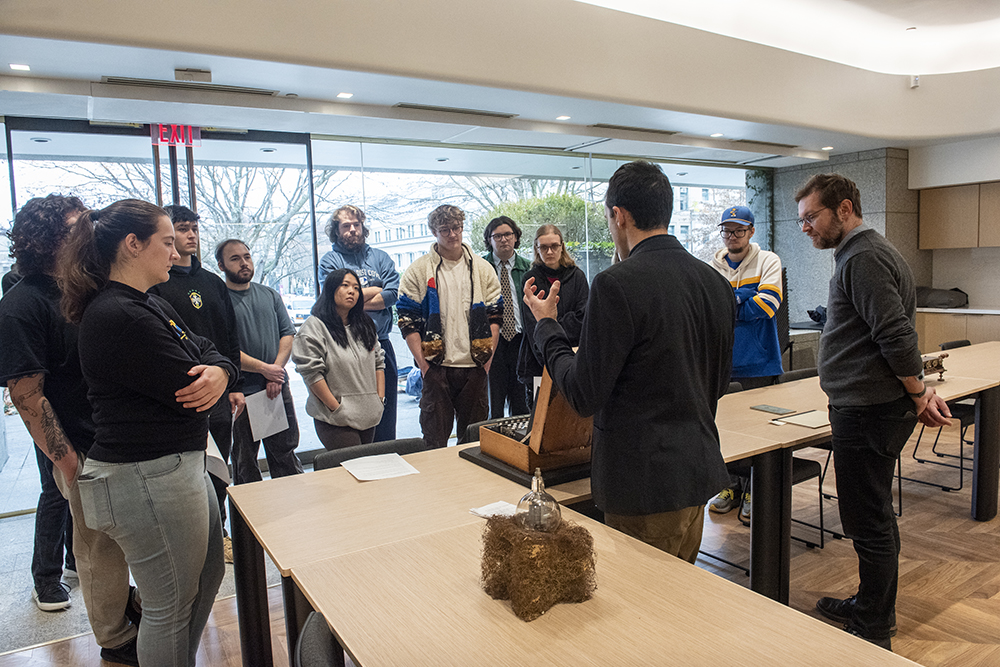
The class, which Burton developed with Associate Professor Annette Vee, looks at the evolution of Large Language Models (LLMs) from a historical perspective. Students explore the history of attempts to automate the process of writing over the centuries, looking at devices like 18th century automatons and Enigma machines and papers like Alan Turing’s 1950 “Computing Machinery and Intelligence.”
They also studied a parallel transformation in the history of mathematics, tracing the transition from human computers to mechanical devices through inventions like the Leibniz Calculator and Genaille’s Rods. At the Posner Center, they had a chance to see many of these materials firsthand.

“CMU is sitting on a goldmine of the history of computing,” Burton said. “And if you have a collection about the history of computing, then you have a collection I can use to talk about the history of writing. My students have often said they didn’t realize there’s such a long history of attempts to automate writing. Humankind has been trying to do this for a long time, and to actually see the physical artifacts and get a sense of that time was really compelling for them.”
Their visit to the Posner Center offered an opportunity to connect these historical shifts with contemporary questions about AI. The visit was structured as an experiment: students took photos of items from the collection, and uploaded them to ChatGPT, asking the chatbot to explain what they were. Sometimes it guessed correctly; sometimes it did not.

“My class is also about cutting through the hype and realizing that AI is good at certain things, but doesn’t replace people,” Burton added. “It needs human intervention to be successful, and that’s something the students got to see firsthand.”
The Art of the Archive
Faculty within the Libraries are also eager to take advantage of the newly expanded access to the Posner Center. This semester, Arts and Humanities Librarian Jill Chisnell is teaching a class titled “The Art of the Archive” within the School of Art. She jumped at the chance to show her students some of the objects contained within Special Collections.
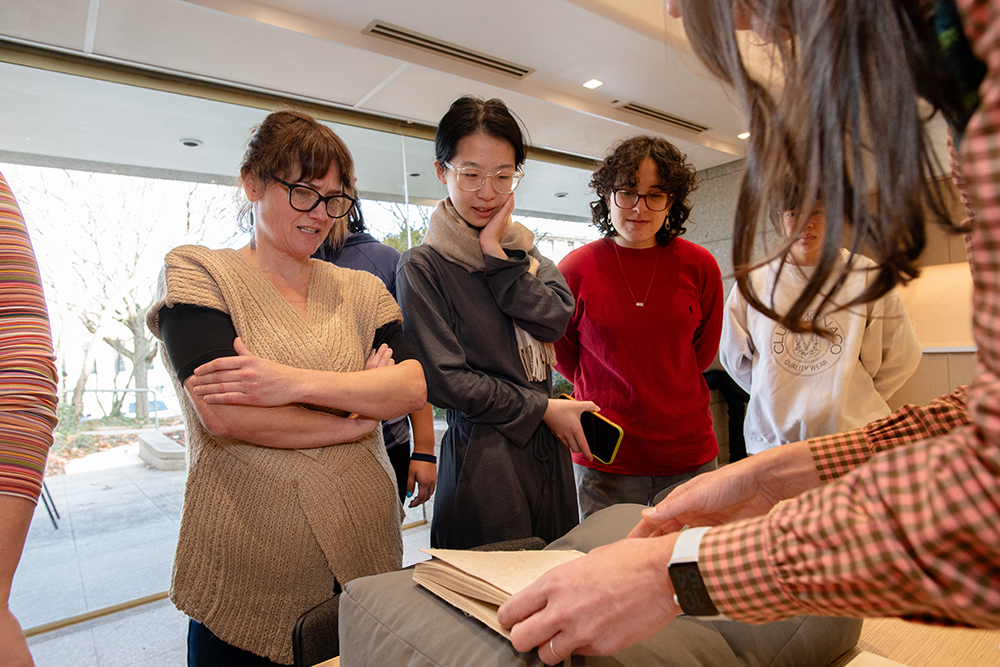
Her students had already visited the University Archives, the Architecture Archives, and Hunt Institute for Botanical Documentation, studying a variety of media and thinking about how artists can interact with and reimagine it, either as a critique, a template for their own work, or as a source of inspiration. At the Posner Center, they had the opportunity to consider how published materials can comprise their own individual archive.
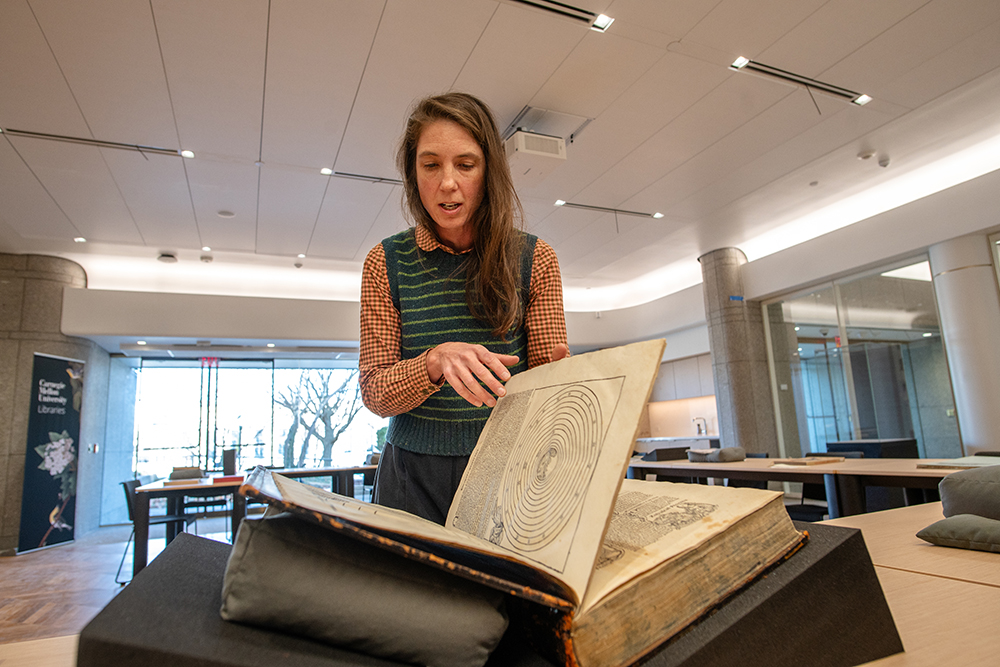
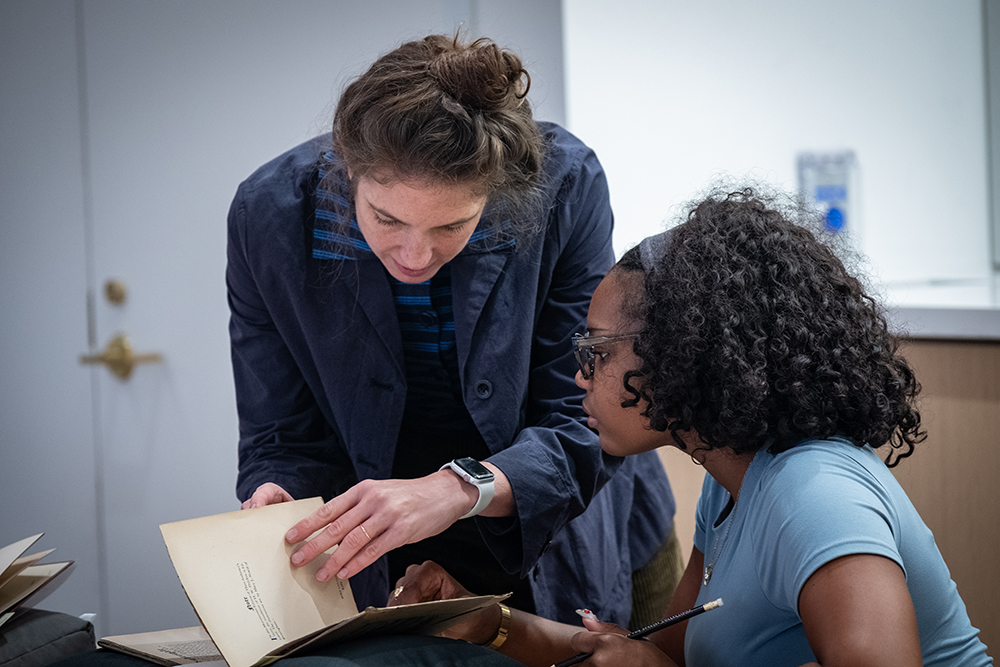
Special Collections Coordinator Catherine Blauvelt invited students to examine a selection of materials with that lens in mind, asking questions like “Who made this?” “Who is excluded from this?” “Who owned these objects, and who didn’t?” From fifteenth- and sixteenth-century texts like the Nuremberg Chronicle to nineteenth- and twentieth-century archives of spaces like a multi-volume set documenting William H. Vanderbilt's Fifth Avenue mansion and art collection, from computing zines to recipes for creating paper, she led the class on a journey focused on power and preservation.
“It’s so cool to know that students have access to all this,” said College of Fine Arts fifth-year senior Natalia Ramirez, who got to experience Special Collections for the first time during the class. “The Posner Center is literally an entire place with these incredible resources right at your fingertips — you can learn about something like Josef Albers’ color theory in class, and then come here and experience it in a physical way.”
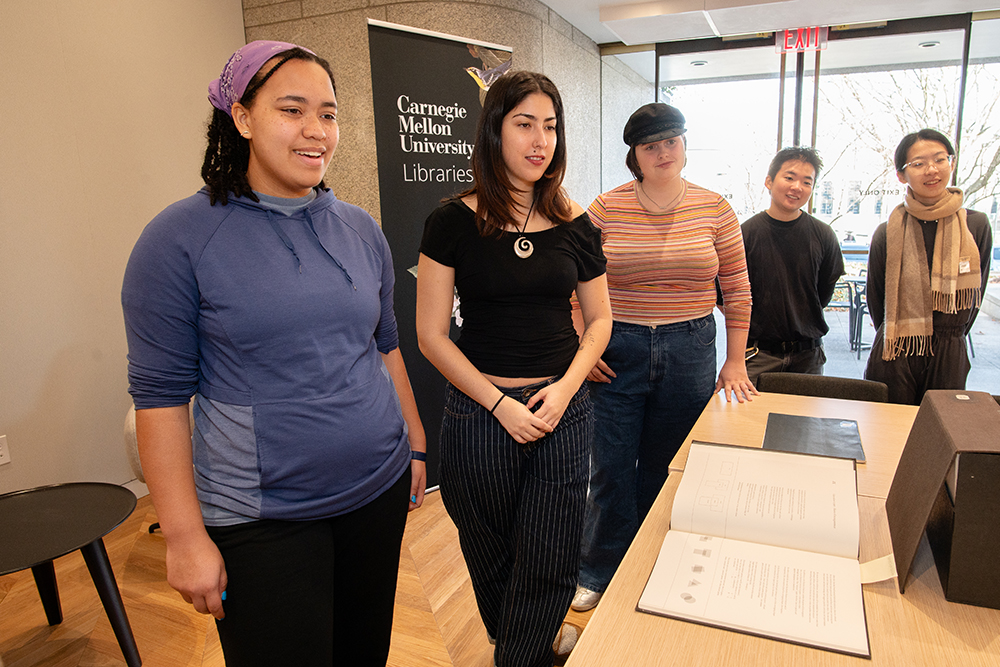
The Posner Center for Special Collections is open to visitors Tuesday through Friday from 10 a.m. to 3 p.m., with extended hours from 3–7 p.m. on Thursdays to view the exhibition (the reading room is closed during this time). Community members can also book a research appointment or a class visit by contacting Special Collections.