A Crucible of Change

A Crucible of Change: Carnegie Tech & the First World War

Crucible of Change: Carnegie Tech and World War I is a journey through Carnegie Institute of Technology's (CIT) involvement in the First World War, as told through letters, pictures, and stories from the University's Archives and other partners, including Soldiers & Sailors Memorial Hall & Museum.

These artifacts tell how CIT's wartime transformation—on its grounds and in its classrooms—helped the United States prepare its Standing Army to fight in the European theater and spurred its evolution into an international research university.

This exhibit honors the history of the CIT campus and the students, faculty, and staff who supported and opposed the war effort.

Duration October 11, 2026 06:12 - October 11, 2026 06:12
Duration August 31, 2026 - July 9, 2027
Location Hunt Library Gallery & Baker Hall
Curator Julia Corrin
Art Director Heidi Wiren Kébé

Exhibit Photos

A Crucible of Change exhibit
Entrance to WWI exhibition in Hunt Library

Wall of Honor dedicated to Carnegie Mellon University students who died during WWI.
A Soldier’s Progress and The Carnegie War Verse, 1918.

Letter, 1918. Carnegie Tech received letters from across the country—including from men already in service—seeking admission to the Bandmaster program. Military band work was safer than the front lines and paid better than most enlisted positions. This letter from C. Forsythe a Black musician was labeled
Letter, 1918. Carnegie Tech received letters from across the country—including from men already in service—seeking admission to the Bandmaster program. Military band work was safer than the front lines and paid better than most enlisted positions. This letter from C. Forsythe a Black musician was labeled “colored” by Carnegie Tech staff. The military remained strictly segregated during World War I but several Black military bands served with Black combat units. World War I Records Carnegie Mellon University Archives.
The Arrival & Departure of Soldiers, 1918-1919. E. F. Reed who served as the Secretary for War Courses at Carnegie Tech maintained this log during 1918 and 1919. He dutifully noted when training detachments came and went and which courses they participated in.The log also recorded key events on campus including an “influenza ban”on October 19th.The Armistice and the lifting of the quarantine arrived on the same page on the same day: November 11th. World War I Records Carnegie Mellon University Archives.

Civil Liberties & Protest
WWI Installation
WWI Installation


WWI Photos

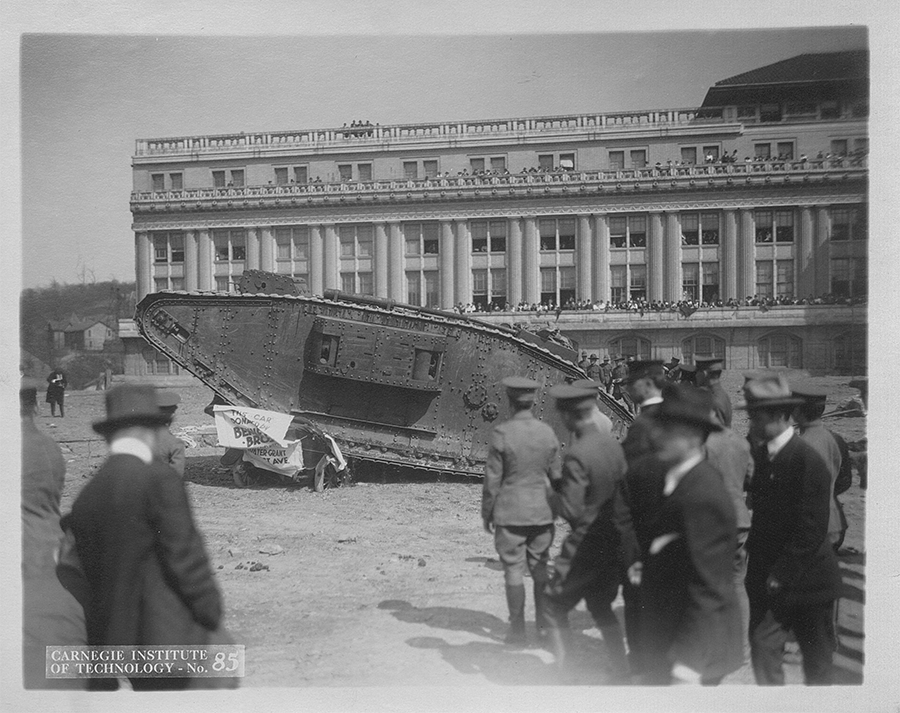
Tank Britannia, 1918. Tank Britannia―a retired British tank―toured the country to raise money for the war by selling Liberty Bonds. On April 27th the tank undertook public demonstrations on Carnegie Tech’s campus. The next day an estimated 100000 people came to Flagstaff Hill next to campus in the Oakland neighborhood of Pittsburgh to view the tank and hear speeches. World War I Records Carnegie Mellon University Archives.

The Tooters, 1918. The American Expeditionary Force operated over 200 bands in France with approximately 7500 musicians in total. To help train these musicians Carnegie Tech operated the only Band Musician program outside of the Army’s school at Fort Jay New York. Tech trained two fifty-person bands before the war ended. World War I Records Carnegie Mellon University Archives.
Campus Trenches, 1918. To prepare students and soldiers for the type of war they would face in France engineering students learned to construct trenches on campus which were then used for rifle training. World War I Records Carnegie Mellon University Archives.

Red Cross Nurses, 1918. Nurses assigned to care for the soldiers on campus pose in front of Margaret Morrison Carnegie College―Carnegie Tech’s women’s college. World War I Records Carnegie Mellon University Archives.
Dedication of the Langley Aeronautical Laboratory, 1918. Langley Aeronautical Laboratory was built in just twenty-three working days to provide a space for soldiers to learn how to repair airplanes. The dedication featured remarks from local dignitaries troops in formation and planes driven across campus to be housed in the new building. The building was named for Samuel Langley an aviation pioneer and the first director of the Allegheny Observatory. World War I Records Carnegie Mellon University Archives.

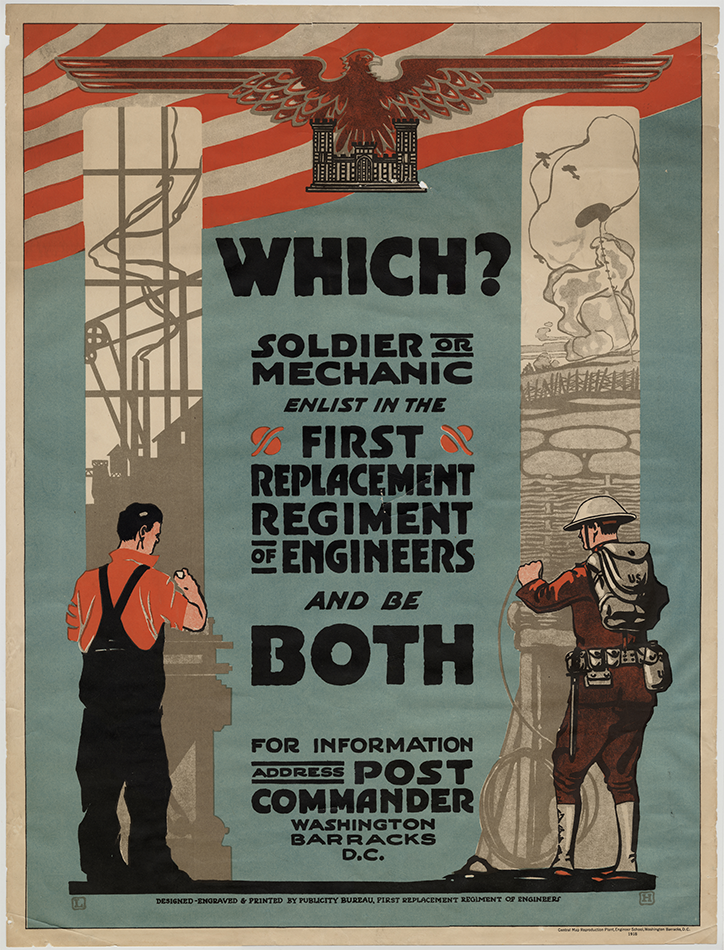
World War I was the first widespread use of government propaganda. These colorful propaganda posters were plastered across buildings in cities and towns urging individuals to join the military purchase Liberty Bonds or conserve food. In addition to celebrating the American war effort they vilified and dehumanized “the Hun” a pejorative used by the British and Americans to describe German soldiers. All posters courtesy of the Library of Congress and the National World War I Museum.
World War I was the first widespread use of government propaganda. These colorful propaganda posters were plastered across buildings in cities and towns urging individuals to join the military purchase Liberty Bonds or conserve food. In addition to celebrating the American war effort they vilified and dehumanized “the Hun” a pejorative used by the British and Americans to describe German soldiers. All posters courtesy of the Library of Congress and the National World War I Museum.
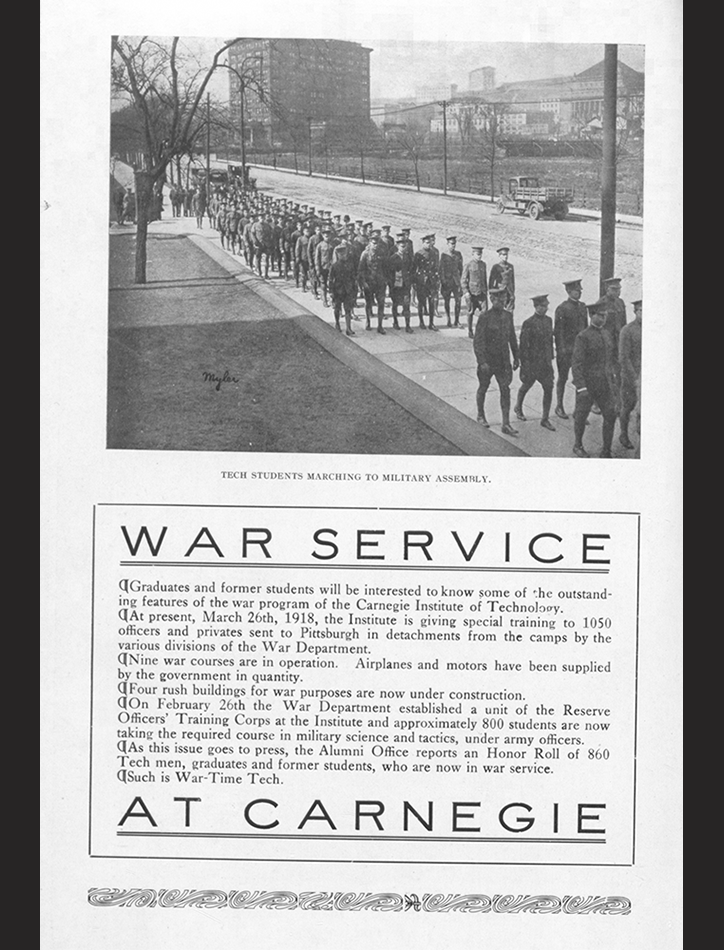
Carnegie Alumnus Vol. 4 No. 31918. World War I Records Carnegie Mellon University Archives.
World War I was the first widespread use of government propaganda.
World War I was the first widespread use of government propaganda. All posters courtesy of the Library of Congress and the National World War I Museum.